,%20viewBox%20cropped%20to%20the%20glyph%20bounding%20box%20so%20the%20box%20the%20CSS%20gives%20it%20is%20the%20box%20the%20logo%20fills%20(aspect%20ratio%2010:3).%20--%3e%3csvg%20xmlns='http://www.w3.org/2000/svg'%20width='200'%20height='60'%20viewBox='45%2025%20200%2060'%20fill='none'%3e%3cpath%20fill='%23192546'%20d='M45,83.98v-40.98h8.62l.65,6.83c1.25-2.38,3.04-4.28,5.37-5.69,2.33-1.41,5.09-2.11,8.29-2.11s6.12.69,8.46,2.07c2.33,1.38,4.12,3.4,5.37,6.06,1.25,2.66,1.87,5.96,1.87,9.92v23.9h-9.67v-22.93c0-3.52-.76-6.21-2.28-8.05-1.52-1.84-3.77-2.76-6.75-2.76-1.95,0-3.69.48-5.2,1.42-1.52.95-2.72,2.29-3.62,4.02-.89,1.73-1.34,3.88-1.34,6.42v21.87h-9.76Z'/%3e%3cpath%20fill='%23192546'%20d='M109.96,84.96c-4.07,0-7.64-.89-10.73-2.68-3.09-1.79-5.5-4.28-7.24-7.48-1.73-3.2-2.6-6.88-2.6-11.06s.85-8.05,2.56-11.3c1.71-3.25,4.12-5.8,7.24-7.64,3.11-1.84,6.73-2.76,10.85-2.76s7.49.89,10.45,2.68c2.95,1.79,5.26,4.17,6.91,7.15,1.65,2.98,2.48,6.37,2.48,10.16v1.75c0,.62-.05,1.32-.16,2.07h-33.33v-6.26h23.66c-.11-2.93-1.11-5.26-3.01-6.99-1.9-1.73-4.26-2.6-7.07-2.6-2.01,0-3.85.46-5.53,1.38-1.68.92-3.01,2.29-3.98,4.1-.98,1.82-1.46,4.11-1.46,6.87v2.36c0,2.55.47,4.73,1.42,6.54.95,1.82,2.24,3.21,3.86,4.19,1.62.98,3.49,1.46,5.61,1.46,2.28,0,4.16-.49,5.65-1.46,1.49-.98,2.56-2.25,3.21-3.82h9.92c-.65,2.49-1.86,4.76-3.62,6.79s-3.92,3.63-6.46,4.8c-2.55,1.17-5.42,1.75-8.62,1.75Z'/%3e%3cpath%20fill='%23192546'%20d='M151.99,84.96c-3.69,0-6.86-.6-9.51-1.79-2.66-1.19-4.76-2.82-6.3-4.88-1.55-2.06-2.45-4.44-2.72-7.15h9.76c.22,1.14.7,2.17,1.46,3.09.76.92,1.73,1.67,2.93,2.24s2.63.85,4.31.85,2.94-.23,3.94-.69,1.76-1.07,2.28-1.83c.51-.76.77-1.57.77-2.44,0-1.35-.34-2.37-1.02-3.05-.68-.68-1.68-1.23-3.01-1.67-1.33-.43-2.97-.81-4.92-1.14-1.84-.38-3.69-.84-5.53-1.38-1.84-.54-3.48-1.26-4.92-2.15-1.44-.89-2.59-2.02-3.46-3.37-.87-1.35-1.3-3.01-1.3-4.96,0-2.38.64-4.54,1.91-6.46s3.14-3.43,5.61-4.51c2.47-1.08,5.35-1.63,8.66-1.63,4.82,0,8.63,1.09,11.42,3.25,2.79,2.17,4.46,5.23,5,9.19h-9.27c-.33-1.52-1.1-2.7-2.32-3.54-1.22-.84-2.86-1.26-4.92-1.26s-3.73.39-4.84,1.18c-1.11.79-1.67,1.83-1.67,3.13,0,.87.34,1.62,1.02,2.28.68.65,1.65,1.23,2.93,1.75,1.27.52,2.89.96,4.84,1.34,3.04.54,5.72,1.23,8.05,2.07,2.33.84,4.17,2.05,5.53,3.62,1.35,1.57,2.03,3.8,2.03,6.67,0,2.66-.68,4.97-2.03,6.95-1.36,1.98-3.28,3.52-5.77,4.63s-5.47,1.67-8.94,1.67Z'/%3e%3cpath%20fill='%23192546'%20d='M191.34,83.98c-2.76,0-5.16-.43-7.2-1.3-2.03-.87-3.6-2.3-4.71-4.31-1.11-2-1.67-4.72-1.67-8.13v-19.11h-7.07v-8.13h7.07l1.14-10.81h8.62v10.81h11.06v8.13h-11.06v19.11c0,2.06.43,3.48,1.3,4.27.87.79,2.38,1.18,4.55,1.18h5.04v8.29h-7.07Z'/%3e%3cpath%20fill='%23192546'%20d='M204.59,83.98v-40.98h8.7l.81,7.64c1.03-1.79,2.25-3.32,3.66-4.59,1.41-1.27,3.12-2.26,5.12-2.97,2-.7,4.23-1.06,6.67-1.06v10.24h-3.5c-1.63,0-3.17.2-4.63.61s-2.72,1.07-3.78,1.99c-1.06.92-1.87,2.17-2.44,3.74s-.85,3.5-.85,5.77v19.59h-9.76Z'/%3e%3cpath%20fill='%23192546'%20d='M233.94,83.98v-40.98h9.76v40.98h-9.76Z'/%3e%3cpath%20fill='%23C89B5A'%20d='M238.82,36.5c-1.79,0-3.27-.55-4.43-1.67-1.17-1.11-1.75-2.48-1.75-4.11s.58-3.05,1.75-4.11c1.16-1.06,2.64-1.59,4.43-1.59s3.26.53,4.43,1.59c1.16,1.06,1.75,2.43,1.75,4.11s-.58,2.99-1.75,4.11c-1.17,1.11-2.64,1.67-4.43,1.67Z'/%3e%3c/svg%3e)
More than price and calendar. 5 things that can increase the number of bookings at your property
When we think about improving results in short-term rentals, the first associations are usually the same: the right price, dynamic rate management, calendar availability, or promotions and discounts on the booking portals.
All of that matters enormously. Yet even the best revenue management will not draw out a property's full potential if the property itself does not answer the needs of the guests who might book it. Sometimes a relatively small change in the furnishings or in how the property is prepared can shift what it is able to sell.
Here are five things worth considering with the maximisation of rental revenue in mind.
1. Using the space well for sleeping places
One of the first criteria worth looking at is how well the available space is used.
In smaller properties what matters most is a comfortable place to sleep for the basic number of guests. In the bedroom the best solution is usually a full-size double bed, and in the living room a good-quality sofa bed, if the property is meant to take more people.
If the flat has one or two bedrooms, a classic double bed may be the most versatile choice. It is worth remembering, though, that the double bed itself can also be a real selling point. If it is wide enough, it pays to state its type precisely on the booking portals, for instance as a queen bed or a king bed. For many guests the width of the bed is an important criterion, especially on longer stays.
In larger properties you can afford more flexible configurations. If the flat has more than two bedrooms, it is worth considering two single beds in one of them instead of yet another double. That widens the ways a stay can be configured, and the property becomes more convenient not only for families and couples, but also for groups of friends, several couples or people travelling for work.
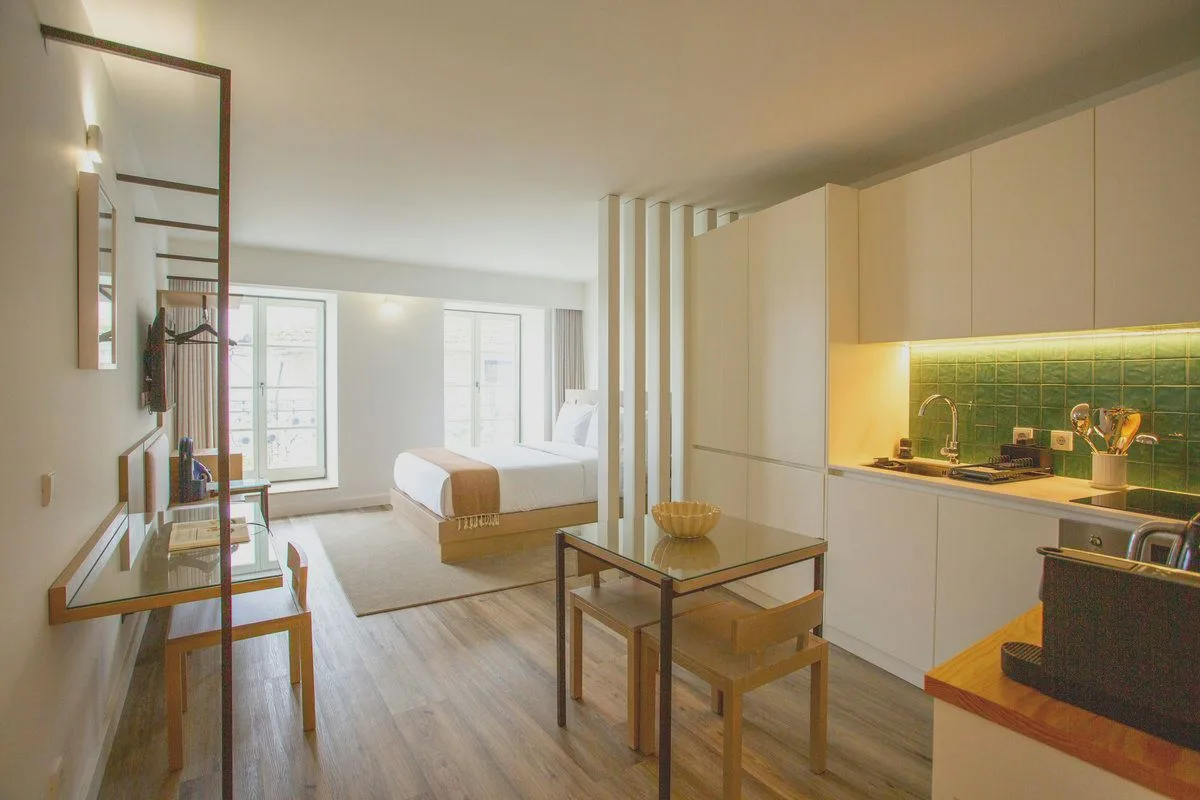
Studios are a special case. Here we often meet the temptation to replace a traditional bed with a sofa bed in order to gain more space during the day. From the point of view of short-term rentals, that is not always the best choice.
For many guests a city studio is the equivalent of a hotel room. After a whole day of travelling, sightseeing or working they want to walk in and see a comfortable bed, ready and made. Having to unfold a sofa and prepare a place to sleep takes away from the stay, and the sofa itself, even a good one, rarely feels like a full-size bed.
That is why, if the floor space allows it, in a studio intended for short-term rental we recommend above all a full-size bed rather than a sofa bed.
2. The furnishings should match the number of guests you advertise
The number of sleeping places alone is not enough to make a property attractive to a larger group. If the listing is meant for six or eight people, the whole space and its furnishings should let that many guests use it comfortably.
This is a common detail that is easy to overlook. The listing allows a booking for six or eight people, but there are four chairs at the table. There are five glasses in the cupboard, a small set of dishes, and no room in the hallway for the coats, shoes and luggage of the whole group. On longer stays too few hangers or not enough space in the wardrobes can also become a problem, especially when guests arrive in winter.
If we state that the property can take a certain number of guests, everything about how it functions should be adapted to that number.
So it is worth checking whether all the guests can sit down at the table at once and share a meal, whether we have enough chairs, plates, glasses, mugs and cutlery, and whether the shared space really does let everybody use it comfortably.
Details like these directly shape the experience of the stay and, in consequence, the reviews left on the booking portals. Guests will often forgive a small floor area if the property is well organised. They judge far more harshly the situation where the listing promises comfort for a larger group but on arrival the basic furnishings simply are not there.
It is worth looking at the layout of the flat in the same way. With larger groups, privacy matters more and more. Bedrooms that close, being able to use the bathroom without walking through a room where somebody else is sleeping, or a sensible split between the day and night areas can decide whether the property appeals to two families, several couples or a group of friends.
The maximum number of guests should not be merely a number typed into the settings on Booking.com or Airbnb. It should reflect the way the property can actually be used.
3. A place to work remotely can open the property to new groups of guests
Remote work has permanently changed the way some people travel.
A guest no longer always leaves only for a weekend or a holiday. They may come for a few days, work during the day and spend their free time exploring the city or resting in nature. Hence the growing popularity of the idea of a workation, combining remote work with a trip.
For that guest a coffee table and Wi-Fi are not enough. If the space allows it, it is worth creating a comfortable place to work with a desk or a suitable table, a chair, good lighting and, above all, fast and stable internet.
This applies both to city apartments, where people travelling for work stay, and to holiday properties. A cabin in the mountains, by a lake or in the forest can in this way interest somebody who, instead of coming from Friday to Sunday, decides to stay from Wednesday to Sunday and work the first two days remotely.
In large cities it is worth taking an even broader view. Alongside short business stays, bookings for several weeks, a whole month or even a quarter are also popular (so-called mid-term rental). These are used by employees relocated to a city, people working on temporary projects and companies looking for accommodation for their staff or contractors. This way of working is especially common in the IT sector.
A property with a comfortable place to work, fast internet, enough storage space and a functional kitchen can therefore appeal not only to tourists but also to corporate clients and companies looking for long stays. That is particularly valuable, because it helps win bookings on weekdays, off season and outside the most obvious holiday dates.
4. Allowing pets increases the number of bookings
Owners often wonder whether to allow stays with pets. Concerns about extra cleaning or possible damage are understandable, but it is worth looking at the other side of that decision as well.
For some guests the option of coming with a dog is not an added convenience. It is one of the basic criteria for choosing a property.
This matters particularly in holiday locations and in properties set in nature. A family planning a week by the sea, in the mountains or by a lake often does not want to, or simply cannot, leave the dog in somebody else's care for several days.
If our property does not take pets, that family may reject the listing at the filtering stage, whatever its price, standard or location. The profile will not even appear in the search results of the many guests who tick the "travelling with a pet" filter from the start.
The pet policy should of course be thought through. You can set the rules of the stay, charge an extra fee or limit the number of animals. It does not have to mean anything goes.
It is worth making that decision consciously, though, because a pet-friendly property can compete for a group of bookings that stays entirely out of reach for some other listings.
5. Easy, contactless check-in
A few years ago handing over the keys in person, by the owner or whoever looked after the flat, was completely natural. Today more and more guests expect to be able to let themselves in. The reason is simple: it gives them far more convenience.
If check-in requires meeting at a particular hour, the guest has to predict before they even set off exactly when they will arrive. Meanwhile the train can be late, the motorway can jam, children can force an extra stop, and the journey can simply take longer than expected.
Instead of starting the stay with phone calls and an anxious search for a new handover time, the guest can receive instructions and enter the property whenever they actually arrive.
One of the simplest solutions is a lockbox, a key safe secured with a code. Even more convenient are electronic locks or handles opened with a code. In that case an individual code can be generated that works only for the period of a given guest's stay. No physical keys have to change hands, and once the booking ends the code expires.
It suits both sides: the guest gains independence, and the owner does not have to arrange their day around the arrival time of every next booking.
A property's potential starts with how it is prepared
Increasing the number of bookings does not always call for a large investment or a complete change of standard. Sometimes it is enough to use the available space better, match the furnishings to the number of guests advertised, create a comfortable place to work, open up to people travelling with pets or simplify the check-in process.
That is why at Nestri we take a broader view: we analyse not only the listing itself, but also who it can be sold to and which guest needs are still worth taking into account. The best results come when the sales strategy begins while the property is still being prepared.